
Laparoscopic Hernia Surgery in Gurgaon
Your abdominal wall holds your intestines in place, but if a weak spot develops in this wall, the intestine can start pushing out of it, especially if it gets strained. It may slip back in when you lie down, so many people wait and hope it settles, but often, it doesn’t. In that case, hernia treatment becomes important. One of the minimally invasive ways of treating hernia is through Laparsocopy, and if you are looking for laparoscopic hernia surgery in Gurgaon, the first step is to find out which hernia you have and whether it needs repair.
Dr. Suyash Rawat, Senior Consultant in General Surgery at The Signature Hospital, Gurugram, has over 15 years of surgical experience and an MS in General Surgery. He assesses each hernia to explain whether it can be monitored or needs laparoscopic or open repair. This guide covers the symptoms, diagnosis, treatment options, recovery and costs to help you understand what to expect.
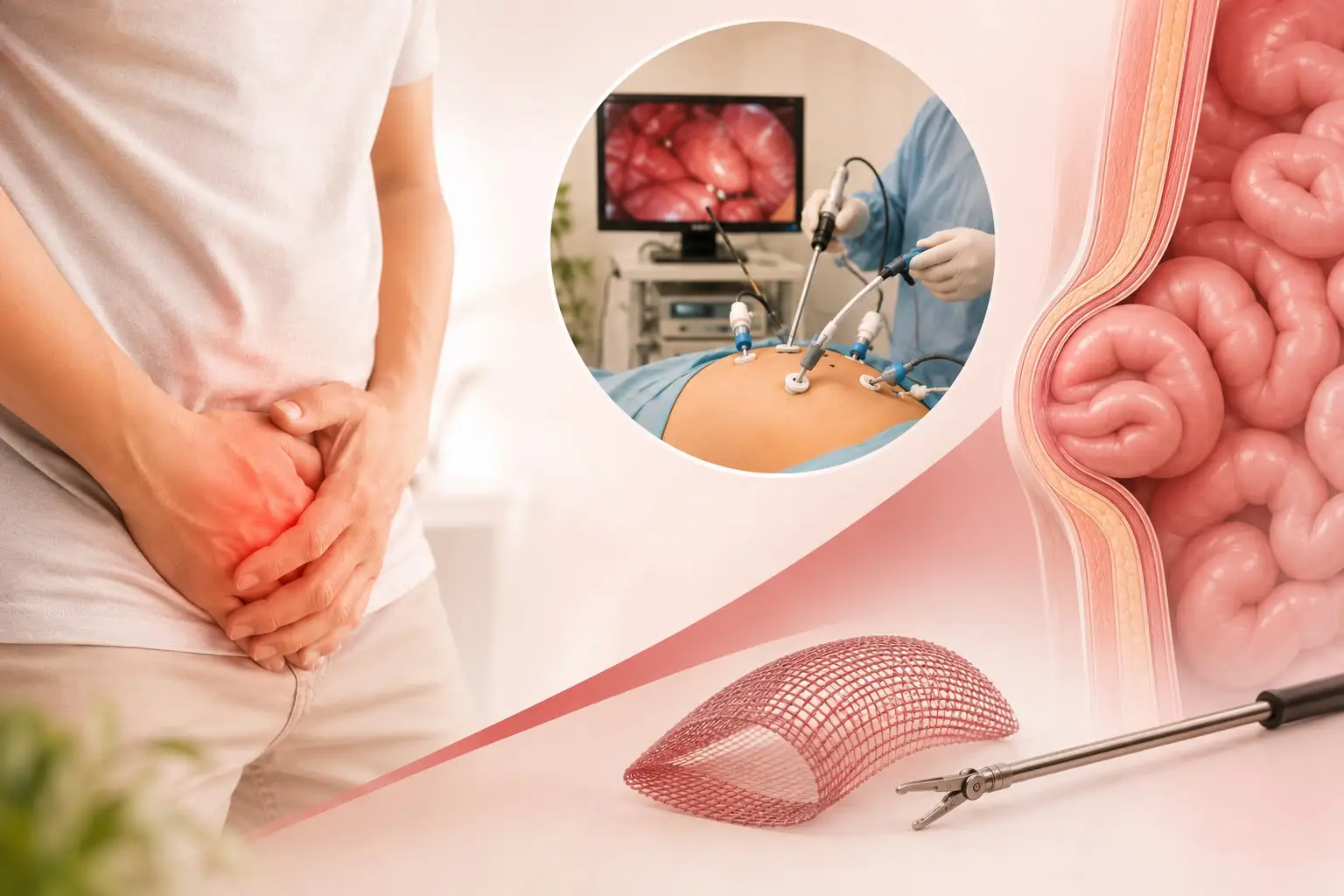
What Is a Hernia?
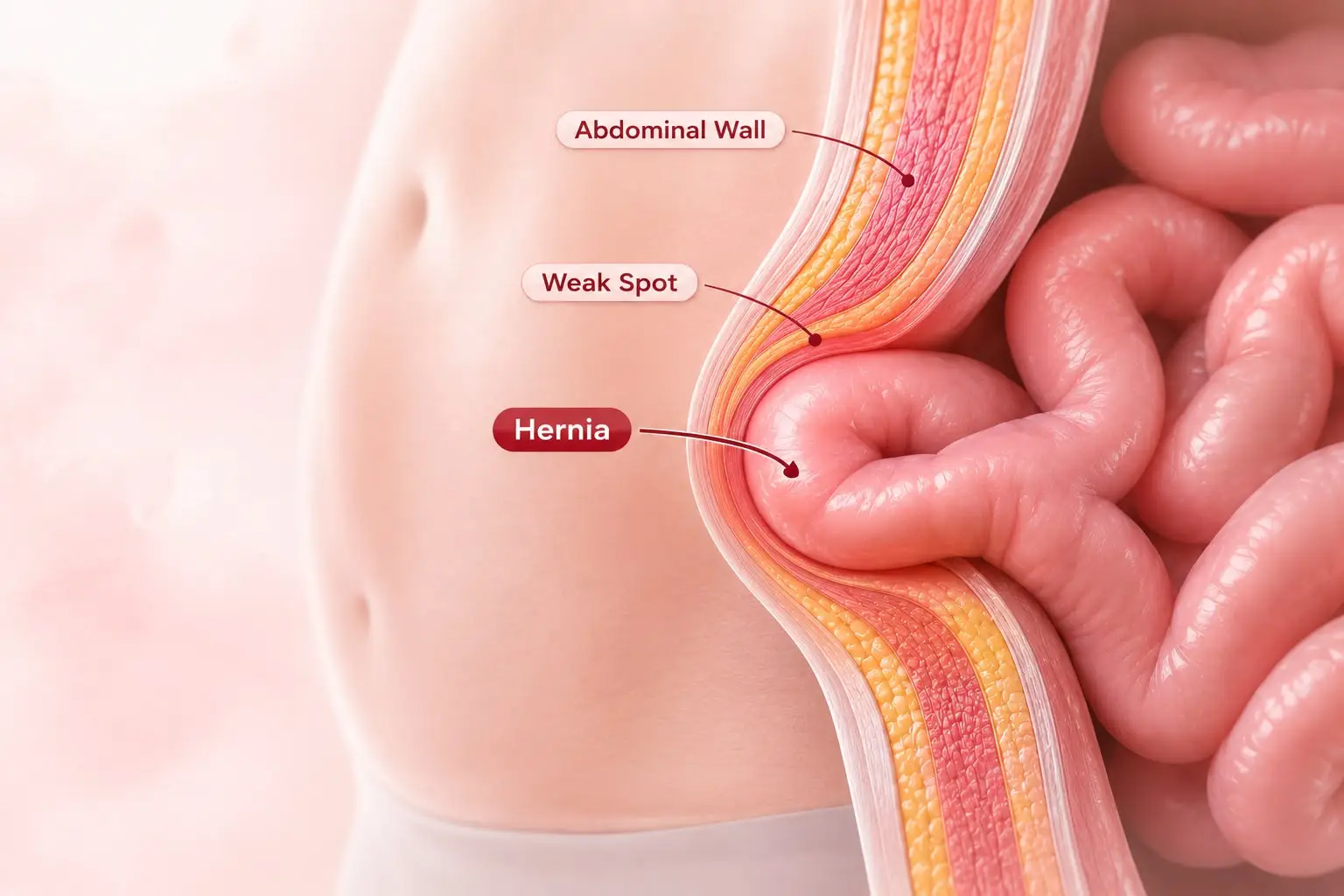
A hernia is a bulge that forms when fat or a loop of intestine pushes through a weak spot in your abdominal muscle wall. Think of a tyre: the tyre wall is your belly muscle, the inner tube is your intestine, and the air is the pressure in your belly. If the outer wall is thin at any spot, the pressure inside the inner tube causes it to bulge out.
How does a hernia form?
- The abdominal wall has layers of muscle that hold your organs in place.
- A weak spot or gap develops, often in the groin, near the navel or at an old scar.
- Coughing, lifting or straining pushes tissue against the gap.
- Tissue slips through in a pouch called the hernia sac, creating a lump.
- The lump may slip back when you lie down, but the gap remains.
- In adults, the defect usually does not close on its own and may widen over time. It may widen, causing the lump to grow.
Where do weak spots come from?
- Natural gaps (the groin canal and the navel)
- Ageing thins muscle
- Earlier surgery
- Family history
What adds pressure on hernia?
- Heavy lifting
- Long-term cough or smoking
- Constipation and straining
- Straining to pass urine
- Pregnancy and weight gain
Where Do Hernias Appear?
Depending on where a hernia appears, they can be of following types:
- Inguinal: Groin; common in men.
- Femoral: Below the groin; more common in women and more likely to get trapped.
- Umbilical: Near the navel.
- Epigastric: Between the navel and lower chest.
- Incisional: At a previous surgical scar, such as a C-section.
The type of hernia helps determine the repair method, and spotting a hernia early gives you more choices about how and when to repair it.
How to Recognise a Hernia: Hernia Symptoms
One of the main symptoms of hernia is a soft lump in the groin, near the navel or on a surgical scar. It may enlarge when standing, coughing or straining and shrink when lying down.
Common Signs of Hernia:
- A visible or palpable bulge
- Dull ache, pulling or heaviness
- Discomfort while lifting, bending or coughing
Seek emergency care if you have:
- Sudden, severe pain
- A hard lump that will not go back in
- Redness over the lump
- Vomiting, abdominal swelling or inability to pass gas or stool
These may indicate a trapped hernia that has lost its blood supply, requiring emergency treatment. Even a painless lump should be checked.
Reach Out for Expert Care
Hernia Diagnosis
Most hernias are diagnosed by simply looking and feeling. The surgeon examines you standing and lying down, and may ask you to cough so the bulge shows up.
- Your history: when the lump started and what makes it worse.
- Examination: to check its location, its size, and whether it goes back in.
- Ultrasound: used when the lump is not clear.
- CT or MRI scan: used for large or scar hernias, or when the diagnosis is uncertain.
The examination also tells the surgeon how urgent the repair is and which method may suit you.
What Is Laparoscopic Hernia Surgery?
Laparoscopic hernia surgery means surgery is performed through a few small cuts (called portals), instead of a large one. This is why laparoscopic surgeries are known as keyhole surgeries.
Through these portals, a camera and surgical instruments go in. The surgeon sees the real time view of the inside of the body on a monitor screen and repairs the weak spot.
Laparoscopic Hernia Surgery Procedure
Here is a step-by-step guide to how laparoscopic hernia procedure is performed:
Anaesthesia
- General anaesthesia is given to the patient.
- Patient falls asleep; does not feel the procedure.
Small cuts
- Small cuts are made (each 0.5–1 cm)
- Camera and instruments go in.
Creating working space
- Gas gently expands the abdomen
- Working room is created for surgeon
Camera and instruments
- A thin camera provides a magnified view of the hernia on a screen.
- Surgery is performed through thin instruments.
Repairing the hernia
- The surgeon moves the protruding tissue back.
- Repairs the weak spot.
Placing the mesh
- A sterile mesh supports the weak area.
- Reduces recurrence risk.
- Usually stays in place permanently.
Closing the cuts
- The gas and instruments are removed.
- Cuts are closed with stitches or surgical glue.
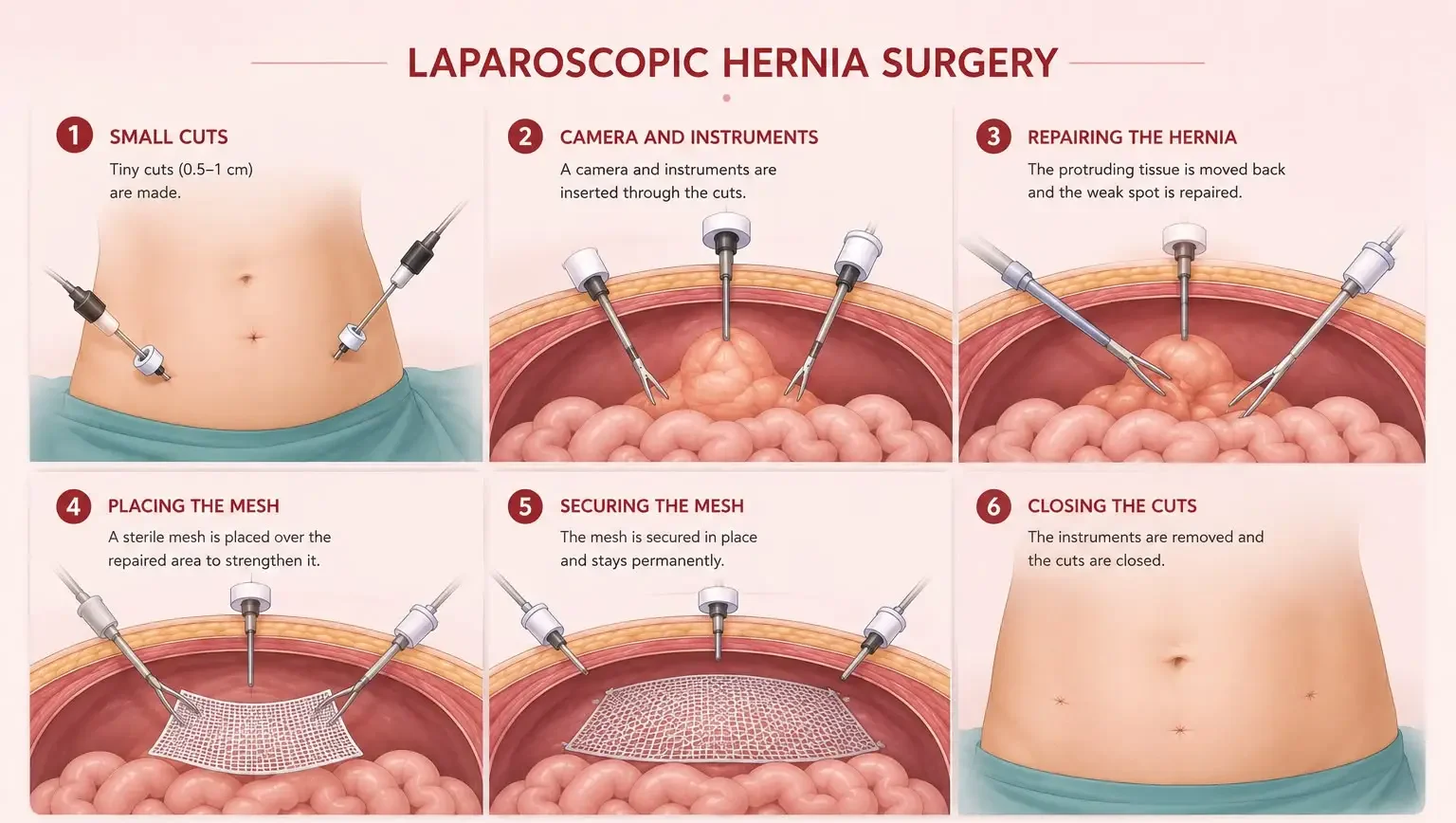
Unlike open surgery, laparoscopic repair uses several small cuts instead of one larger incision.
Laparoscopic vs Open Hernia Surgery: Which Is Better?
Neither approach is best for everyone. Both repair the weak spot, usually with mesh.
Laparoscopic repair may suit when:
- Smaller cuts and quicker recovery are preferred
- The hernia is on both sides or has returned after open surgery
Open repair may suit when:
- Local or spinal anaesthesia is safer
- The hernia is very large or complicated
- You have had major surgery in the same area
Your surgeon recommends the approach based on your hernia and health.
Who Is a Good Candidate for Keyhole Hernia Repair?
You may be suitable for laparoscopic hernia surgery if you can safely undergo general anaesthesia and your hernia suits the keyhole method.
When may another approach be safer?
- Heart or lung conditions that increase anaesthesia risks
- Previous major abdominal or pelvic surgery
- Very large hernias
- Emergency cases involving trapped bowel
Your surgeon decides after an examination and necessary tests.
Laparoscopic Hernia Surgery Recovery
Recovery time after hernia surgery depends on type of hernia, repair and health. You may go home the same day or stay overnight. Desk work is often possible within 1–2 weeks.
Recovery tips after hernia:
- Take short walks.
- Use prescribed pain medicines.
- Avoid heavy lifting and intense workouts for several weeks, as advised.
- Avoid straining during urination or bowel movements.
When to call your surgeon:
- Fever
- Increasing pain
- Swelling or discharge from the incision
Attend follow-ups to check healing and resume normal activities safely.
Laparoscopic Hernia Surgery in Gurgaon Cost
Laparoscopic hernia surgery in Gurgaon typically costs ₹50,000 – ₹1,50,000, depending on the hernia and hospital.
What affects the cost?
- Hernia type and size
- One or both sides
- Mesh type
- Room category and hospital stay
- Previous surgery or recurrence
Dr. Suyash Rawat can provide an estimate after examining your hernia and confirming its type and size.
Reach Out for Expert Care
Why Consult Dr. Suyash Rawat for Laparoscopic Hernia Surgery in Gurgaon?
Dr. Suyash Rawat is a general and laparoscopic surgeon and a Senior Consultant in General Surgery at The Signature Hospital, Gurugram, with over 15 years of surgical experience.
- Training: MBBS from R.D. Gardi Medical College (2007) and MS in General Surgery from MGM Medical College and Hospital (2011).
- Fellowships: FMAS, FIAGES and FICRS.
- Keyhole expertise: Advanced training in laparoscopic surgery for hernia repair.
- Membership: World Association of Laparoscopic Surgeons (WALS).
- Approach: Explains options, from watchful waiting to laparoscopic or open repair, based on your hernia and health.
The suitable repair is decided after an examination. Dr. Rawat also treats related conditions through general surgery.
Book a Consultation for Laparoscopic Hernia Surgery in Gurgaon
To confirm whether your lump is a hernia and if it needs repair, book a consultation with Dr. Suyash Rawat.
At your consultation, Dr. Suyash Rawat will check the following:
- Medical history
- Symptoms
- Needed tests
- Treatment options
- Estimated cost of treatment
Bring your symptoms, past surgery and medication details, and previous reports. For sudden severe pain, a hard lump that won’t go back in, or vomiting, seek emergency care.
FAQs
Senior liver specialist with extensive experience in transplant and complex liver care.
Does every hernia need surgery? expand_more
No. Small, symptom-free groin hernias may be monitored. Painful, growing or high-risk hernias usually need surgery.
Which hernias can be repaired laparoscopically? expand_more
Many inguinal, umbilical and incisional hernias can be repaired laparoscopically, depending on their size, complexity and your surgical history.
What is the success rate of hernia surgery? expand_more
Most patients do well after hernia surgery, but outcomes depend on the hernia type, surgical technique and individual health.
Can a hernia come back after surgery? expand_more
Yes, though it is not common. The risk depends on hernia size, technique, smoking, weight and straining after surgery.
What are the risks of hernia surgery? expand_more
Mild pain, bruising and swelling are common after surgery and usually improve with recovery. Less common complications depend on the hernia type and surgical approach.

Dr Suyash Rawat's Medical Content Team
Dr Suyash Rawat’s medical content team specialises in creating accurate, clear, and patient-focused healthcare content. With strong clinical understanding and expertise in technical writing and SEO, the team translates complex medical information into reliable, accessible resources that support informed decisions and uphold Dr Suyash Rawat’s commitment to quality care.
 WhatsApp